Injuries
How do you train with a cranky knee without losing strength?
A sore knee is not a reason to stop lower-body training. Here is how to keep loading your legs, which movements to adjust, and how to tell good discomfort from a warning sign.
Drafted for review by Dr. LaMar Sheppard, DC · August 6, 2026 · 7 min read
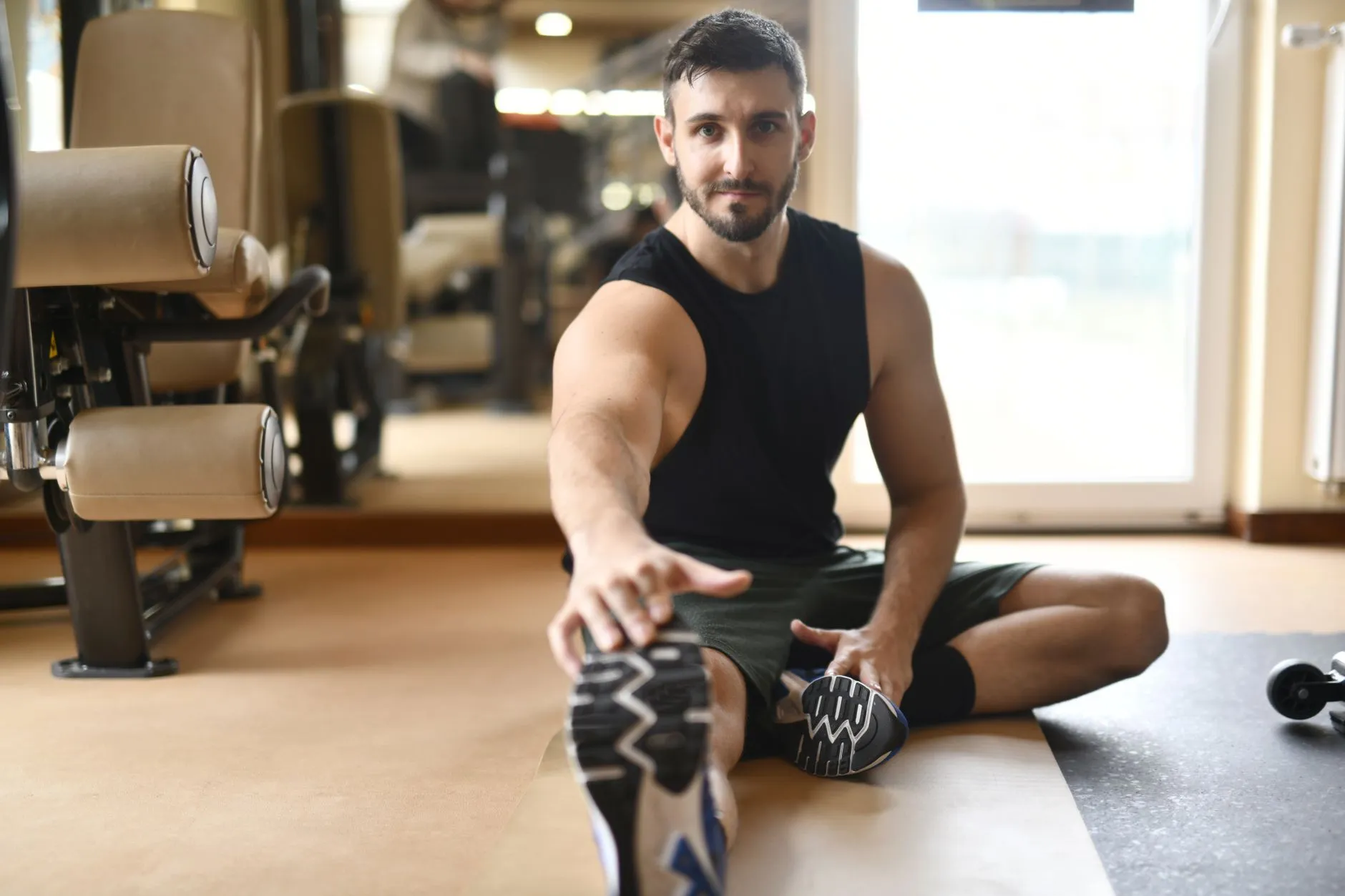
A cranky knee is the most common reason men in their fifties quietly stop training their legs. It is also one of the worst decisions available, because the muscles that protect the knee are exactly the ones that disappear first when you stop.
This is how Doctor of Strength approaches it with online clients: keep loading the leg, change how it is loaded, and let a simple weekly number tell you whether the plan is working. Nothing here replaces an assessment of your own knee, and a few situations below need a physician before a program.
Should you stop training legs when your knee hurts?
Usually no. For most men over 45 with a sore but stable knee, stopping lower-body training trades a short-term relief for long-term weakness. The better move is to reduce the load or change the movement until the knee settles to mild, short-lived discomfort, then build back gradually from there.
The evidence for keeping the knee working is unusually strong for a musculoskeletal problem. The 2019 American College of Rheumatology and Arthritis Foundation guideline strongly recommends exercise for knee osteoarthritis, the most common cause of a nagging knee after fifty. It does not rank one form above another: walking, strengthening, neuromuscular training and water-based exercise all count. And the AAFP’s summary of that guideline makes a point that matters for anyone training alone: exercise tends to work better when it is supervised.
That last sentence is the whole argument for having someone watch the trend with you. Not because the exercises are complicated. Because the adjustments are.
When stopping is the right call
Some knees need a physician before they need a program. Stop training that leg and get it examined if the knee:
- is hot, visibly swollen, or swelled up quickly after an incident
- locks, catches, or gives way under you
- cannot take your weight
- hurts at night in a way that does not change with position
Those are not “train around it” knees. They are “find out what it is” knees.
What makes a knee cranky in the first place?
A knee usually complains because the load it is asked to carry has outpaced what its tissues are currently prepared for. That can be a weekend of pickleball after a sedentary month, a squat that went deeper than the joint has been trained to go, or an older problem that never fully settled. The fix is almost always the same: manage the load, then raise capacity slowly.
This is the weekend-warrior pattern in one sentence. Weekday desk, weekend sprint. The tissue adapts to the average week, and then the Saturday asks for something it has not been prepared for.
It also explains why rest alone rarely fixes it. Rest lowers the demand, but it lowers the capacity too. The first hard Saturday back, the gap is exactly where it was.
How do you keep loading the leg without aggravating the knee?
Change the variables before you change the exercise. Depth, tempo, load, stance and the order of your session can each make a squat or lunge tolerable without dropping it. Most irritable knees accept a shallower, slower, slightly lighter version of the same pattern, and that version still builds the thigh and hip muscles that support the joint.
The practical adjustments, roughly in the order worth trying:
- Reduce the range. Squat to a box set just above where the knee starts to complain. Lower the box gradually over weeks, not sessions.
- Slow the lowering. A three-second descent at a lighter load is usually kinder to an irritable knee than a quick bounce at a heavier one, and it still works the muscle hard.
- Move the load. A goblet squat or a trap bar often feels different to a knee than a barbell on the back. So does a split stance.
- Train the hip hard. Hip hinges, glute bridges and hip thrusts put much less demand on the front of the knee and build the muscles that steady it.
- Keep the single-leg work, carefully. Step-ups to a low box and split squats expose side-to-side differences that bilateral lifts hide.
None of this is exotic. The skill is in choosing which variable to change for your knee, and how quickly to change it back.
What about running and court sports?
Running, pickleball and tennis add impact and fast direction changes on top of strength. While the knee is settling, most people do better holding those at a steady volume, or trading one session a week for cycling or a rower, rather than dropping them completely. How long that lasts depends on the knee, which is why it belongs in an assessment rather than a rule.
How do you know if you are doing too much?
Use a simple 0 to 10 score for the knee, recorded at the same time each week, and watch the trend rather than any single day. Mild discomfort that settles within a day is generally acceptable. A score that climbs week on week, or pain that is still worse the next morning, means the load outran the knee’s capacity and needs to come down.
This is the same scale used inside Foundation 90: a pain and stiffness score from zero to ten for each joint that has been limiting you, collected every week. It is deliberately simple. A number you record every week is worth more than a detailed diary you abandon in the second.
A useful way to read it:
- Score steady or falling while load slowly rises: progress. Keep going.
- Score up one or two points for a day after a harder session, then back: the knee noticed. Hold the load for a week before adding more.
- Score rising over two or three weeks: the plan is too aggressive. Reduce, then rebuild more slowly.
The first thirty days of Foundation 90 carry a one-line standard for exactly this reason: nothing flares. Progress in month one is not a heavier squat. It is a knee that stops dictating your calendar.
Why does leg strength matter more after 50?
Because strength is one of the things that most reliably fades with age, and the muscles around the knee are among its first casualties. Guidance from the World Health Organization recommends muscle-strengthening work on at least two days a week for adults, and three days of varied strength and balance work for older adults, precisely because capacity is easier to keep than to rebuild.
The WHO 2020 guidelines put it plainly: adults should do muscle-strengthening activities involving the major muscle groups on two or more days a week, and older adults should add multicomponent work emphasising functional balance and strength on three or more days a week.
For a man trying to keep skiing, surfing, paddleboarding or walking eighteen holes, that is not an abstract public-health target. The quadriceps and hip muscles are the knee’s shock absorbers. Let them fade and the same weekend asks more of the joint every year.
What if a knee replacement has already been mentioned?
Then the work is the same, and it matters more. Plenty of men in their fifties have heard a surgeon say “eventually” about a knee. Whether and when a replacement is needed is a decision for you and your orthopedic surgeon, and no training program can promise to prevent one.
What you control is the condition of everything around the joint. The same guideline that recommends exercise for knee osteoarthritis recommends strengthening and, where it applies, weight management. Stronger quadriceps and hips, a lighter load on the joint, and a knee that is used rather than protected are worth having either way: they are how you stay active in the years before a decision, and they are the base you would rehabilitate from if surgery does come.
In practice that means the program below, with your surgeon’s advice built into it rather than filed away. If you are already on a surgical pathway, tell us on the call, and the plan is written around what your surgeon has said.
What does a knee-friendly training week look like?
Three strength sessions, each opening with preparation specific to that day, and at least one of them built around the knee’s current tolerance rather than yesterday’s numbers. Conditioning continues on a bike, rower or incline walk. The joint score decides the pace of progress, not the calendar.
An outline, not a prescription:
- Day 1, lower body: box squat to a tolerable depth, hip hinge, split squat at a short range, calf raises.
- Day 2, upper body plus hip: presses and pulls, with glute bridges and a loaded carry.
- Day 3, lower body: step-ups, trap bar deadlift, hamstring curls, single-leg balance work.
- Between: Zone 2 conditioning on whatever the knee tolerates best that week.
In Foundation 90 this lives in Everfit, updated monthly and sooner when the knee or the calendar changes. Clients travelling that week get the hotel-gym version. More on that in how to train in forty minutes with a hotel rack.
When should you get the knee assessed?
When the knee has changed your plans more than twice in a season, when it is worse after rest rather than better, or when you have no idea why it hurts. An assessment turns “my knee is bad” into a specific limiter and a specific plan, which is the difference between guessing and progressing.
That is what The Baseline is for: sixty minutes, a review of any imaging you already have, and a written report that names what is actually limiting you and what has to change first. It is a remote assessment and coaching service, not a diagnosis, and decisions about imaging or treatment stay with your own physician.
If you would rather start smaller, the free 14-day challenge gives you two weeks of workouts and a meal plan to see how the approach feels.
The short version
A sore knee is information, not a verdict. Keep loading the leg, change how you load it, record a weekly number, and let the trend make the decisions. Get it examined if it swells, locks or gives way. And stop letting it quietly retire the strongest muscles you have.
Quick answers
1 Should I stop squatting if my knee hurts?
Usually not entirely. Most knees tolerate a squat that is shallower, slower or loaded differently. Reduce depth or load until the knee settles to a mild, short-lived discomfort, then build back. Stop and see a physician if the knee is hot, swollen, locking or giving way.
2 Is some knee pain during exercise acceptable?
Mild discomfort that settles within a day and does not grow week on week is generally acceptable while training an irritable knee. Pain that is sharp, rising session to session, or still worse the next morning means the load was too high for now.
3 Is exercise recommended for knee osteoarthritis?
Yes. The 2019 American College of Rheumatology and Arthritis Foundation guideline strongly recommends exercise for knee osteoarthritis, including strengthening, walking and neuromuscular training, and notes that outcomes tend to be better when the exercise is supervised.
4 How long before a sore knee tolerates normal training again?
It varies with the cause and the person, which is why a timeline without an assessment is guesswork. What matters week to week is the trend: a joint score that holds steady or falls while the load slowly rises is progress.
5 Can I still run or play pickleball with a sore knee?
Often, with changes to volume and surface, but the answer depends on why the knee hurts. That is a question for an assessment rather than an article, because the same symptom can mean different things.
Sources
- Kolasinski SL et al. 2019 American College of Rheumatology/Arthritis Foundation Guideline for the Management of Osteoarthritis of the Hand, Hip, and Knee. Arthritis Care & Research, 2020 (PubMed 31908149)
- American Academy of Family Physicians. Osteoarthritis Management: Updated Guidelines from the ACR and Arthritis Foundation (2021)
- Bull FC et al. World Health Organization 2020 guidelines on physical activity and sedentary behaviour. British Journal of Sports Medicine (PMC7719906)
General information, not medical advice. Licensed to practice chiropractic in California. Coaching services are provided nationwide and are not a substitute for medical care from your own physician. Prescribing decisions rest with a licensed physician.